Outreach and delivery of fire refugia datasets and products
VERSIONING. Our v4 fire refugia products based on 2021 GNN data are now available. These include scenarios: holistic refugia p10W, holistic refugia p50W, holistic refugia p90W, and holistic refugia p10FWG, p50FWG, and p90FWG. To access these updated data layers use the Fire Refugia Toolbox > Library of data resources (fire refugia map layers for download).
We have developed numerous Outreach Materials to help socialize the fire refugia datasets and concepts.
This page will continue to be developed as new research is published and data are updated.
Feedback always welcome!
The fire refugia manager's brief
In a nutshell: The manager's brief provides a short summary of the holistic fire refugia and topo-climatic fire refugia products and concepts, and links to all data products and resources for the region. The manager's brief includes an FAQ for ideas relating to management and project planning.
Concepts and models of fire refugia are increasingly a part of forest management discussions in the context of wildland fire and global change. However, translating new science and data products to management decisions and treatment prescriptions is not an easy task. These applications can be better informed by collaboration between scientists and managers to identify best uses of new data products, and spending time creatively discussing and integrating the "so what?"" from science into decisions on the ground. Scientists and managers from the US Forest Service Little White Salmon Forest Resilience and Wildfire Risk Mitigation Project area on the Gifford Pinchot National Forest and Washington State Department of Natural Resources (WA DNR) worked collaboratively with Oregon State University scientists to develop this manager's brief to facilitate integration of fire refugia science into forest project planning, providing a case study for actionable science and a template for future projects using fire refugia concepts across the region.
The fire refugia manager's brief covers two objectives outlined by the Little White Salmon (LWS) project team, as key elements required to effectively integrate fire refugia concepts and products into project-level planning. The first objective is a synthesis tailored to the manager audience describing:
- What are fire refugia? We summarize the concept of fire refugia as locations on the landscape burned less severely and/or less frequently than surrounding areas, and provide an overview of how these concepts can be considered in relatively moist vs. dry landscape settings. We emphasize that our challenge is to identify information on fire refugia pertinent to land management goals and tailored to the focal ecosystem.
- What products are currently available to map fire refugia in the region? We introduce the holistic fire refugia models and the topo-climatic fire refugia models, describe their key components and how they complement each other in the context of refugia science. We briefly introduce the WA DNR Large Dense Forest Sustainability maps and their relationship to fire refugia, and connect all of the work to cornerstone research by Camp et al. (1997) on fire refugia in the Swauk Late-Successional Reserve.
- What are the drivers of fire refugia? We provide a short summary of the models and important variables that contribute to the holistic fire refugia and topo-climatic fire refugia products. We describe the vegetation/fuels, topography, fire weather, and fire growth components of the holistic fire refugia models, and describe the topography and climate components of the topo-climatic fire refugia models.
- Where are fire refugia located in the Little White Salmon project area? We produce maps of the LWS area to showcase fire refugia products in the Resilience Block and High Risk Block of the project area, illustrate multiple scenarios of the holistic fire refugia and topo-climatic fire refugia models, and develop an example of how overlays of the scenarios can provide interpretations valuable for vegetation management decisions.
The second objective was to engage with LWS scientist and manager partners to discuss and summarize potential implications of vegetation management treatments on fire refugia characteristics, including understanding of:
- How do fire refugia overlap with other highly valued resources in the LWS project area? We provide ideas for the types of data that could be useful for map analysis with fire refugia products, and provide an example for using map products of OGSI80 and OGSI200 (mature and old-growth forests) and fire refugia products to inform management decisions and planning.
- What do fire refugia models tell us about management at the stand and watershed scale? We use a Frequently Asked Questions (FAQ) approach to illustrate ideas that can contribute to ongoing community discussion and decisions integrating fire refugia data. We emphasize that the FAQ does not represent prescriptive or comprehensive coverage of the information, but starts a conversation on ideas based on academic and management expertise.
- How could forest management increase the extent and sustainability of refugia? We continue the FAQ format to illustrate ideas for management informed by fire refugia products.
The report concludes with:
- Additional resources on fire refugia. We provide a collection of resources related to fire refugia concepts, including links to data products, webinars, copies of journal articles, links to websites, etc.
We look forward to ongoing evolution of conversations and implementation of fire refugia concepts and data within this community of practice, supporting effective management decisions in the context of climate change.
Webinars
Links to short presentations from the 2023 Post-Fire Research and Monitoring Symposium with relevance to fire refugia
- Merschel et al. (2023). 800 years of post-fire forest development data in west side Douglas-fir forests. Presented for the 2023 Post-Fire Research and Monitoring Symposium.
- Krawchuk et al. (2023). Fire refugia, old forests, & spotted owls. Presented for the 2023 Post-Fire Research and Monitoring Symposium.
- M. A. Krawchuk. 2021. Fire refugia: where and why do conifer forests persist through multiple fire events. Presented for the Forest Stewards Guild.
Posters
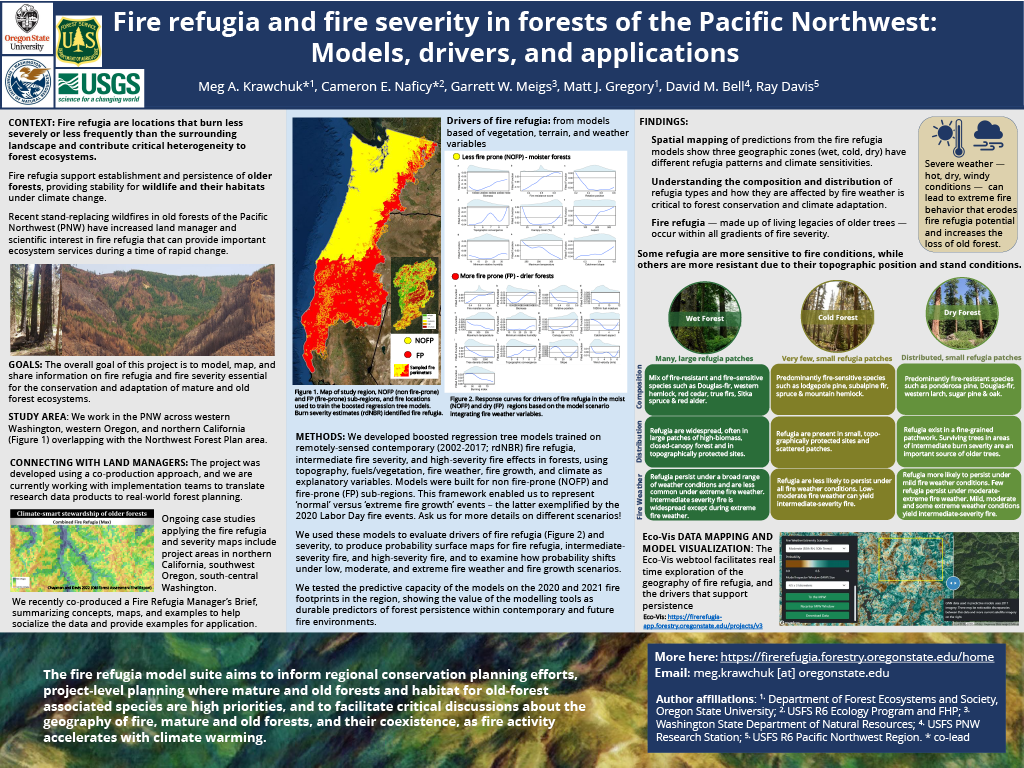
Infographic
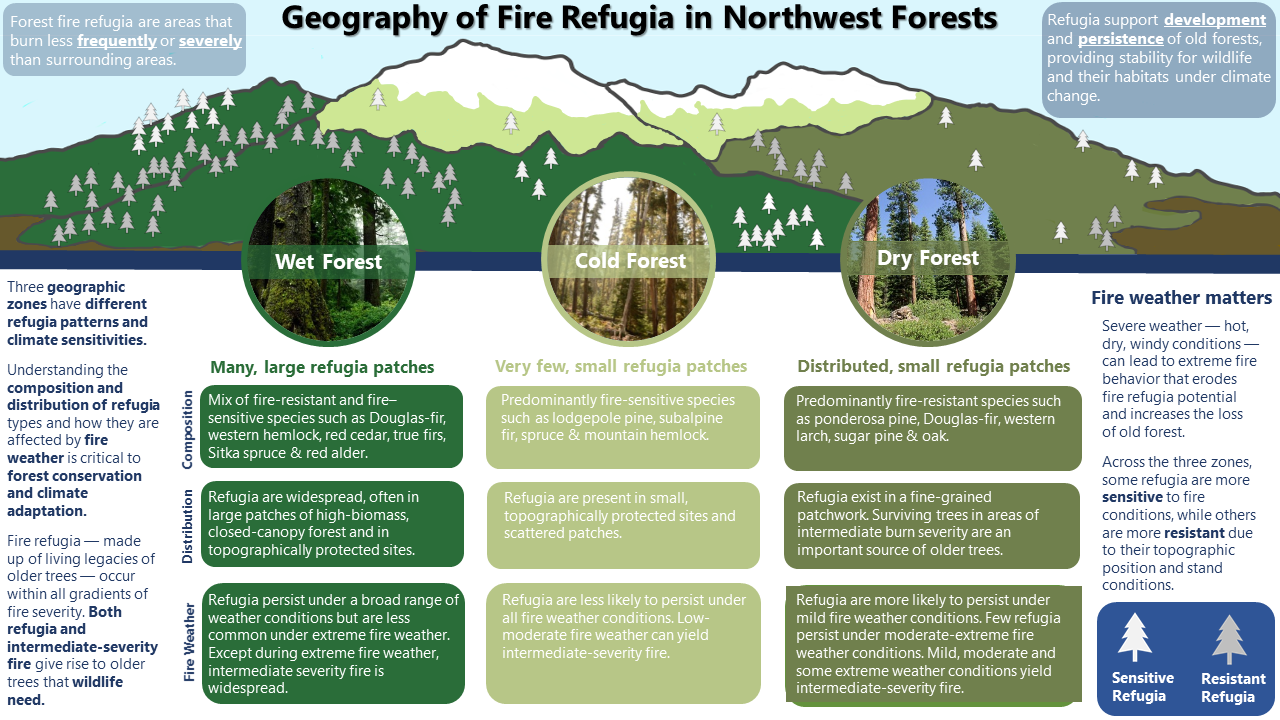
Link to full-size infographic (PNG)
Interactive materials from journal article Aparicio et al (2026) "Exposure and carbon risk for mature and old-growth forests from severe wildfire in the Pacific Northwest, U.S.A."
Click here to explore Interactive Materials of fire refugia for mature and old-growth forests
Abstract: Mature and old-growth forests (MOG) provide essential ecosystem services, yet they face increasing threats. Currently, high-intensity, high-severity wildfires are the main driver for loss of MOG on federally managed forests across the United States. Quantifying MOG forests with greatest exposure to stand-replacing wildfires provides essential information for land managers. We integrated geospatial data from fire behavior simulations (fire intensity), fire refugia prediction (fire severity), forest type mapping, and carbon estimates to assess exposure of MOG forests to stand-replacing wildfires in national forests within the Northwest Forest Plan region of the Pacific Northwest. We show that ca. 75% of MOG exposure is in areas with historically frequent, low-severity fire, that fire refugia capacity may help mitigate exposure between 6 to 21% across forest types, and expected carbon emissions are greatest in the Klamath Mountains ecoregion. Our findings demonstrate the geography of exposure for MOG and aim to inform regional priorities for MOG stewardship.
Interactive materials from journal article Rockweit et al (2026) "Fostering landscape resilience and species conservation in frequent fire landscapes"
Click here to explore Interactive Maps of fire refugia for northern spotted owls
Abstract: Restoration of dry forest landscapes of the Pacific Northwest often involves the removal of some closed-canopy forest that has expanded due to fire exclusion, but this can conflict with species conservation when species require closed-canopy forest as part of their habitat. Fire refugia—areas within fire perimeters that burn less severely or frequently—might provide a solution to this conflict. We used a species-specific approach to understanding fire refugia for northern spotted owls to model the post-fire persistence of nesting and roosting (NR) forest in the frequent fire landscapes of the eastern Washington Cascades and the Klamath province and parts of the southern Cascades. Persistent NR forest occurred in topographically-sheltered locations and lower slope positions whereas less persistent NR forest occurred in topographically-exposed locations. These patterns of persistence reflect historical vegetation patterns when complex interactions among topography, vegetation and weather maintained resilient landscapes. These vegetation patterns may also resemble higher quality heterogenous habitat for spotted owls. Our models can help managers achieve the dual objectives of maintaining viable populations of native species, including those that rely on closed-canopy forests, while also restoring resilient landscapes. In an era of rapid ecological change, we suggest that northern spotted owl conservation and fire-adapted landscape restoration are not opposing goals. By identifying the biophysical settings that promote persistent NR forest and acknowledging the role of heterogeneous landscapes for maintaining resilient ecosystems and high quality spotted owl habitat, the dual objectives of supporting long-term resilience for native species and ecosystems can be achieved.